
Progesterone Testing in Dogs, the Operational Version
Last Reviewed: May 16, 2026. Written and reviewed by the BreederHQ Operations Team, working with active dog breeders and reproductive veterinarians.
Progesterone (P4) testing is the closest thing breeders have to a real-time view inside the cycle. Visual signs tell you when she'll stand. They don't tell you when she's ovulating. The gap between those two facts is where missed breedings, small litters, and wasted frozen-semen shipments live.
This page covers the operational side: when to start, how often to pull, what the numbers tend to mean, and how to keep the data organized cycle after cycle. It is not medical advice. Targets and protocols vary by lab and by repro vet, and your vet is the call on any specific cycle.
Why Visual Signs Aren't Enough
She'll Stand Before She's Ovulating
Behavioral receptivity and ovulation aren't the same event. Plenty of dams will stand days before the LH surge and continue standing days after eggs are no longer viable. Breeding on behavior alone catches the window sometimes and misses it the rest of the time.
Frozen and Chilled Semen Demand Precision
Natural breedings with a live cover and multiple ties are forgiving. Chilled semen has hours of viability. Frozen semen has minutes. Get the timing wrong by a day on a frozen breeding and the whole shipment is wasted.
Litter Size Tracks with Timing
Breedings on the wrong side of the optimal window produce smaller litters. The eggs that were fertilized at the edge of viability either don't implant or implant fewer. A six-puppy litter that should have been ten is the silent cost of bad timing.
Stud Owners Expect It
Many stud owners (particularly for in-demand sires and any frozen semen) will require P4 documentation before releasing semen or scheduling a breeding. Showing up with "she seemed ready" is not how the conversation goes.
What the Numbers Generally Mean
These ranges are the conventions most repro vets and breeders work with for canine progesterone reported in ng/mL. They are approximate, lab-dependent, and not medical advice. Your repro vet sets the targets for your cycle.
Below 2 ng/mL
Baseline. Pre-surge. Keep monitoring.
Around 2 to 3 ng/mL
LH surge zone. Tighten the testing interval. Ovulation typically follows about two days after the surge.
Around 5 ng/mL
Ovulation zone. Eggs are released but not yet mature enough for fertilization.
Around 8 to 10 ng/mL
Eggs mature. Fertile window opens. Natural and chilled breedings typically happen in or just past this zone.
Around 10 to 20 ng/mL
Frozen-semen timing zone for many protocols. Higher precision required. This is where the trend across multiple pulls becomes critical.
Above 20 ng/mL
Past optimal for most breeding protocols. Window is closing or closed.
The number you saw matters less than the trend you're seeing. A reading of 4 going to 6 going to 9 is a different cycle than a reading of 9 with no prior data. Single-point progesterone is hard to interpret. A trend is not.
Pulling Cadence and Lab Logistics
First Pull Around Day 5 to 7 of Proestrus
Earlier than that is usually a wasted pull. Later than that risks starting after the surge has happened. For a dam with documented prior cycles, the right starting day comes from her own pattern.
Every Two to Three Days Until You See Movement
Baseline is boring. A flat reading at 1 or below means you're still in the waiting phase. Once you see the first real climb, the cadence tightens.
Daily or Every Other Day Through the Surge
This is the critical window. The surge is fast. Stretching the interval here is where missed breedings happen.
In-House Analyzer vs. Send-Out Lab
Send-out labs (quantitative) are the standard. In-house analyzers give faster turnaround and are common at repro clinics with high cycle volume. Either works. What doesn't work is mixing labs mid-cycle. The trend becomes noisy and harder to read.
Cost Reality
A typical pull runs somewhere between $50 and $150 depending on lab, clinic, and region. A typical cycle uses three to six pulls. The total is real money. It is also a small fraction of what a missed cycle costs in lost litter income, wasted frozen semen, or pushed-back placement timelines.
How Breeders Usually Track P4 Today
A Photo of the Lab Slip
Phone roll fills up with lab slips. Finding the right one means scrolling. Comparing across cycles means scrolling more.
A Notes App
"Ruby, March 14, P4 6.2." Better than nothing. Doesn't plot a trend. Doesn't link to the breeding that came out of the cycle.
A Group Text with the Repro Vet
Vet texts the result, you reply, decision happens in the thread. Works in the moment, useless six months later when you want the cycle history.
A Spreadsheet per Dam
The most common organized approach. Per-cycle columns, dates, values, lab. Works, especially with a chart formula. Falls apart if you have to update it from the road or share it with a co-breeder.
How BreederHQ Logs Progesterone
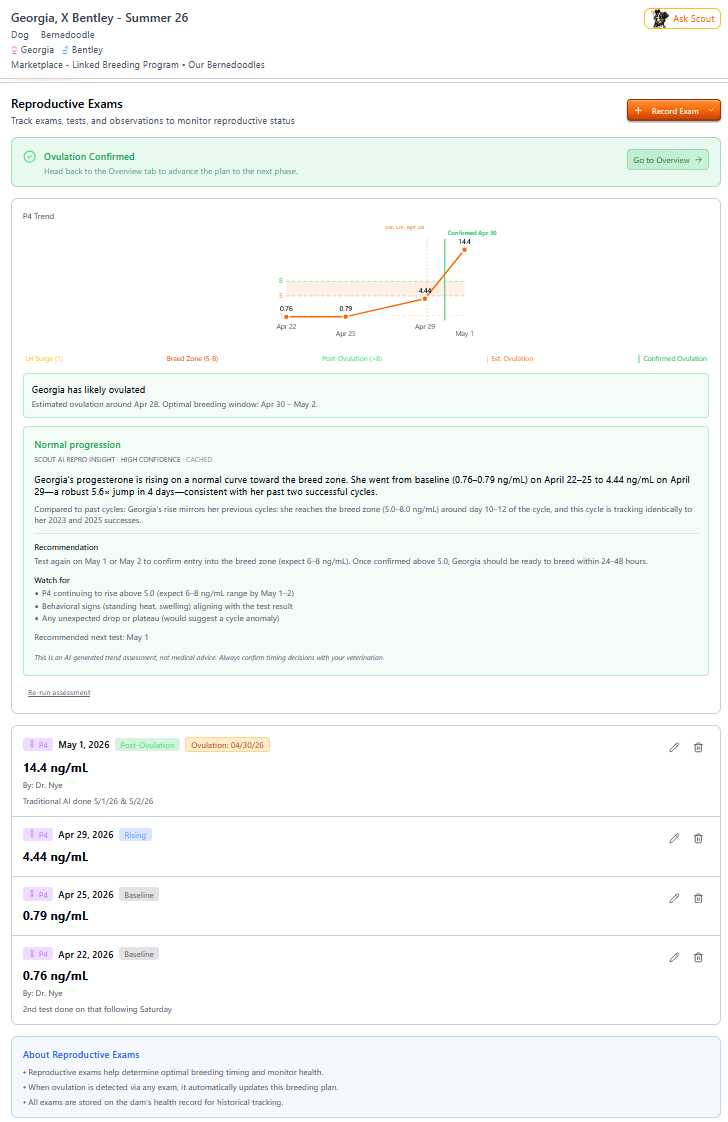
Each P4 reading logs against the specific heat cycle for the specific dam. The trend chart appears from the first reading and updates with each new pull. For canine plans the system projects the breed-zone window automatically and writes a plain-English coaching message that uses the dam's actual name and recommends when to test next.
Past cycles stay accessible side-by-side, so when you're planning this cycle you can see how her last three behaved. Pro and Enterprise plans add Scout AI Repro Insight, an on-demand assessment that compares the current cycle to past cycles and flags split heats or anomalies.
The numbers stay with the cycle. The cycle stays with the dam. The dam stays with the program. Nothing gets lost.
Who Should Be Running P4 Testing
- •Anyone breeding with frozen semen
- •Anyone breeding with chilled semen
- •Breeders using high-demand outside studs where one shot matters
- •Breeders with a dam who's historically missed conception
- •Breeders with a known irregular cycler
- •Anyone trying to maximize litter size for a long-awaited breeding
Who Probably Doesn't Need It
- •Live-cover breedings with on-site stud where multiple ties are easy
- •Programs that consistently get good-sized litters on observation alone
- •One-time breedings where the cost-benefit doesn't pencil out
That said, most breeders who try one or two cycles with progesterone never go back. The data shifts the decision from gut to evidence.
Frequently Asked Questions
When do I start progesterone testing?
Most breeders start around day 5 to 7 of visible proestrus and continue every two to three days until the readings show ovulation has occurred. Starting too early wastes pulls. Starting too late risks missing the LH surge entirely. The pattern of her past cycles tells you when to start for her specifically.
What numbers am I looking for?
The values most breeders track in ng/mL roughly correspond to: baseline below 2, LH surge around 2 to 3, ovulation around 5, eggs maturing around 8 to 10, and the typical breed-zone window for natural or chilled semen around 8 to 20 depending on the protocol your repro vet uses. Frozen semen is timed tighter, usually after eggs have matured. Always defer to your repro vet on exact targets. Labs and protocols vary.
How often should I pull during a cycle?
Every two to three days early, then daily as the numbers start climbing. Once you see a clear rise above baseline you tighten the interval. A typical cycle uses three to six pulls. Going under-tested risks missing the surge; going over-tested wastes money without adding information.
In-house analyzer or send-out lab?
Both work. Send-out labs (quantitative) are the gold standard and what most repro vets use. In-house analyzers turn around faster and are practical for clinics doing many cycles. As a breeder, the call is usually made by which clinic you work with. What matters is consistency: don't mix and match analyzers mid-cycle.
Can I skip progesterone testing if I have a regular cycler?
You can. Plenty of breedings happen on observation alone and produce litters. The reason serious programs test anyway is that observation tells you she'll stand, not that she's ovulating. The cost of testing is dwarfed by the cost of a missed cycle, a small litter, or a chilled or frozen breeding done at the wrong time.
How do I keep track of all the numbers?
A piece of paper works for one cycle if you remember to bring it. A spreadsheet works until you have three dams cycling at once. A system that logs each pull against the right cycle, plots the trend, and tells you when to test next is what serious programs end up using. BreederHQ's progesterone log shows the trend chart from your first reading and writes a plain-English coaching message that uses the dam's name.