
Offspring Care. From Birth to Placement.
You already know how intense birth season gets. Monitoring the dam, tracking individual offspring, documenting weights, watching for problems. Whether you're managing a litter of ten puppies, a doe with triplet kids, twin lambs, or a single foal, BreederHQ keeps everything organized so you can focus on the animals, even at 3am.
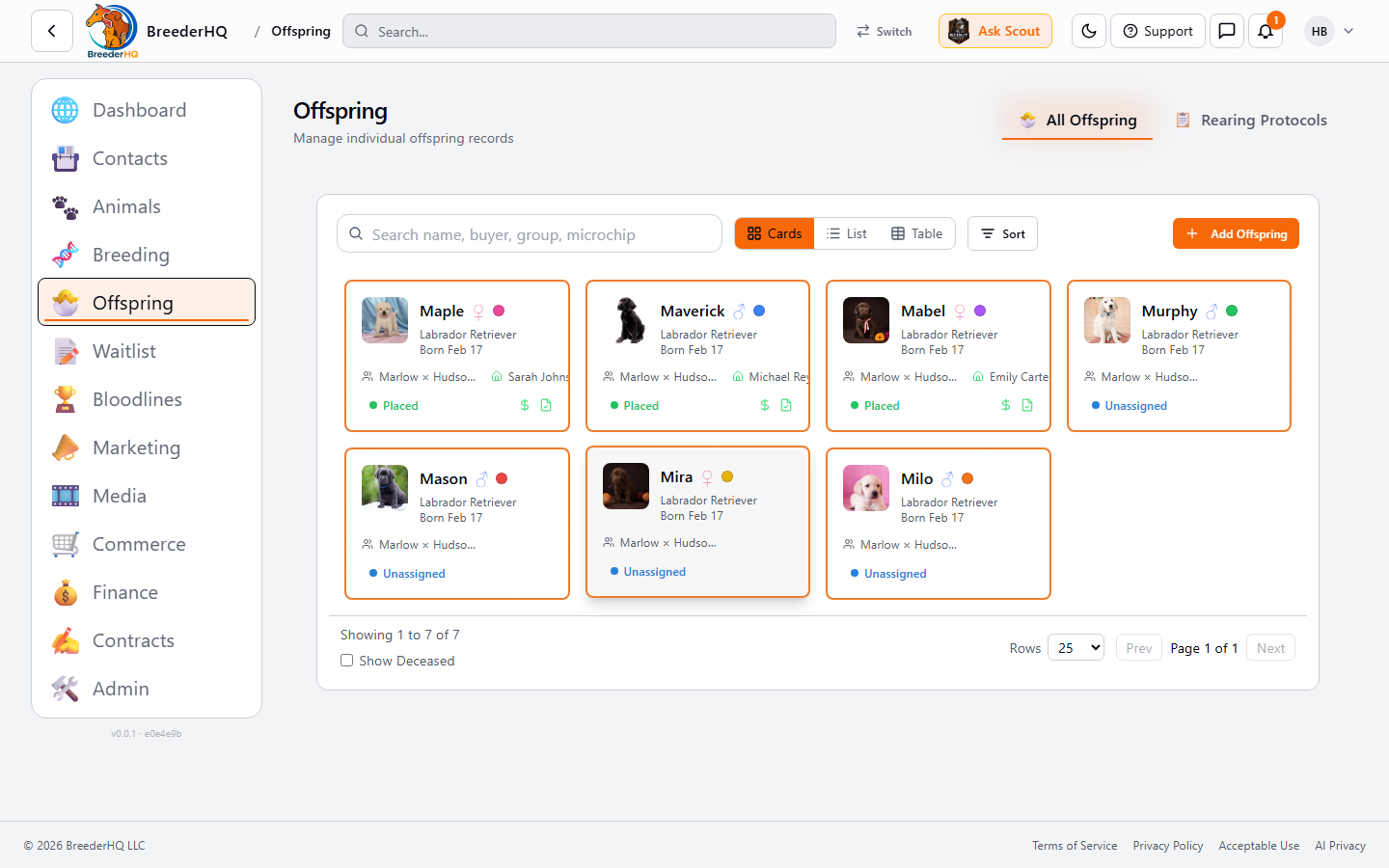
Every newborn in the group: identifier, placement state, paperwork status, and which buyer they're going to.
You're already tracking all of this. Here's why it gets hard.
You do the work. The challenge is keeping it all organized:
- •You can't identify which offspring is which
- •Weight trends are invisible without daily tracking
- •Vet asks about birth weight and you're digging through papers
- •Buyers ask questions about their animal's early days and you have no record
- •You lose track of deworming schedules and vaccination dates
- •Critical information is on scraps of paper you can't find
You already know what's at stake. BreederHQ makes sure the paperwork keeps up with you, even when you're sleep-deprived and running on coffee.
The systems you've been using
Birth charts on paper
Printed charts posted near the birthing area. Write weights daily in pencil. Works great in the moment, but hard to search later or share with buyers.
Spreadsheets
A sheet per offspring group. Columns for each newborn. Rows for each day. Data entry after weighing. It works until your laptop isn't nearby. Or until you need to see the chart on your phone.
Notebooks
Write everything down. Birth times, weights, notes. Finding specific information later means flipping through pages.
Photos with timestamps
Take a photo of the scale. Works for documentation. Terrible for calculating weight gain or spotting trends.
Memory
"The blue collar one was smallest." "I think she weighed about..." You know the information, but pulling it up on the spot is another story when you're exhausted and managing multiple offspring.
Where it starts to get overwhelming
The data adds up fast
A large litter, triplet kids, twin lambs, or even a single foal you're monitoring closely. Twice daily weighing. That's dozens of data points per day. Over weeks, that's hundreds of weights. You're doing the weighing. The hard part is keeping it all organized.
You can see the numbers but not the trends
Is that offspring gaining appropriately? A list of weights doesn't show you the pattern. You know what to look for, but calculating percentage gain manually across multiple offspring is tedious.
Identification gets tricky as they grow
Colored collars or markings work great at first. But as offspring grow and change, keeping track of who's who takes more effort. Photos help, but organizing them is another task on top of everything else.
Birth records don't follow the animal
You've tracked the blue collar offspring from birth. Now they're going to a buyer. Ideally those birth records become part of their permanent record. In reality, they're usually stuck in a notebook or spreadsheet.
Milestones sneak up on you
Deworming schedule. First vaccination. Microchipping or ear tagging. Socialization protocols. These are date-driven tasks. If they're not tracked with reminders, they're easy to miss.
Sharing with buyers takes too long
A buyer wants to know their animal's birth weight and growth pattern. You know the information exists, but pulling it together means scanning paper charts or digging through spreadsheets.
What it looks like when it all comes together
Birth records with due dates
- •Due date auto-calculated from breeding date
- •Birth alerts before expected delivery
- •Actual birth date recorded
- •Birth record connected to both parents automatically
Individual offspring tracking
- •Each offspring identified with collar color or temporary name
- •Birth time and weight recorded
- •Sex, color, markings documented
- •Photos attached to each offspring record
Weight tracking with trend visualization
- •Daily weights captured in seconds from the Mobile Companion app
- •Weight gain patterns shown visually
- •Offspring not gaining appropriately flagged
- •Historical weight data accessible
Milestone and task tracking
- •Deworming schedule auto-generated
- •Vaccination dates tracked
- •Microchipping, ear tags, or tattoos recorded per offspring
- •Reminders for upcoming tasks
Records connected to placement
- •Birth data becomes permanent animal record
- •When placed, buyer gets access to history
- •Birth weight, growth, and milestones shareable
- •No manual transcription needed
Neonatal Care: Save More Newborns
The first weeks are critical. Fading newborn syndrome can take a healthy offspring within hours. Early detection is everything. BreederHQ's neonatal care tracking helps you catch problems before it's too late.
📊 Weight Tracking at a Glance
See each newborn's weight trend without reading a single number. A small inline chart on each row shows the shape of the curve, steady gains, plateaus, or concerning drops.
A downward trend catches your eye before the numbers do, so you spot a fading newborn while there's still time to act.
⚡ Batch Weight Entry
Weighing multiple offspring twice a day? Batch entry lets you log all weights quickly. Enter weights in order, tab to next, done. Works just as well for a litter of ten puppies as for triplet kids, twin lambs, or a single foal.
No navigating between individual records. One screen, all offspring, fast logging.
📝 Care Log Timeline
Document every intervention: tube feeding, supplementing, stimulating, warming. Time-stamped entries create a complete care history.
When the vet asks "what have you tried?", you have documented answers.
🏥 Veterinary Interventions
Track vet visits, treatments, and outcomes per offspring. Link to care logs for complete context.
Critical for insurance, buyer transparency, and your own records of what worked.
⚠️ Weight Anomaly Alerts
BreederHQ automatically flags offspring showing concerning weight patterns:
- •No weight gain in 24 hours - needs attention
- •Weight loss - immediate concern, investigate promptly
- •Below group average - may need supplementation
- •Rapid unexplained changes - investigate immediately
Alerts don't replace your judgment. They make sure you see what matters when you're exhausted at 3am.
Neonatal Care Dashboard
One screen showing all offspring with status indicators:
Status is calculated automatically from weight trends, feeding logs, and care interventions.
How BreederHQ keeps you on top of it all
Birth records with automatic due date calculations. Individual offspring tracking with photos and identification. Daily weight entry that works on your phone right where you are. Weight trends visualized with sparklines so problems are obvious. Automatic weight anomaly alerts to catch fading newborns early. Care log timelines documenting every intervention. Milestone reminders for deworming and vaccinations. Records that connect seamlessly to buyer placements.
You already do the hard work. BreederHQ makes sure nothing falls through the cracks.
Built for breeders who:
- •Have multiple births per year, whether litters, twins, triplets, or singles
- •Track offspring weights and growth carefully
- •Need to identify individual offspring reliably
- •Provide detailed records to buyers
- •Want to stop using paper charts and spreadsheets
- •Need a Mobile Companion app for in-the-moment capture at the barn, kennel, or birthing area
This might be overkill if:
- •You have one or two births per year
- •Small groups or singles that are easy to track by hand
- •Paper charts genuinely meet your needs
- •You don't share detailed records with buyers
If paper works for your program, there's nothing wrong with that. BreederHQ is here when you're ready for something more.
Frequently asked questions
Can I enter weights from my phone right after birth?
Yes. The BreederHQ Mobile Companion app is built for exactly this kind of in-the-moment capture: weigh each newborn, tap the weight in, done. The Mobile Companion is the on-the-go partner to the BreederHQ web app, scoped to quick capture and quick lookup tasks like this one.
Does it track multiple offspring groups at once?
Yes. Each group has its own record with individual offspring tracking. Whether it is a litter of eight puppies, a doe with triplet kids, twin lambs, a single foal, or a herd of calves born across a calving window, the workflow is the same.
Can I attach photos to each offspring?
Yes. Photos help with identification and can be shared with buyers.
Does it remind me about deworming and vaccinations?
Yes. Milestones are tracked and reminders are automatic.
Can buyers access early records for their animal?
Yes. When you place an offspring with a buyer, they can access birth and growth history through their portal.