Pedigrees That Work for You, Not Against You.
Pedigrees tell the story of your breeding program. You already use them to inform decisions, prove lineage, and predict outcomes. BreederHQ makes sure that information is connected, accessible, and easy to share.
Pedigree tools are available across all nine species BreederHQ supports: dogs, cats, horses, goats, sheep, cattle, alpacas, llamas, and rabbits. Same lineage tree, same COI math, same common-ancestor detection across every species.
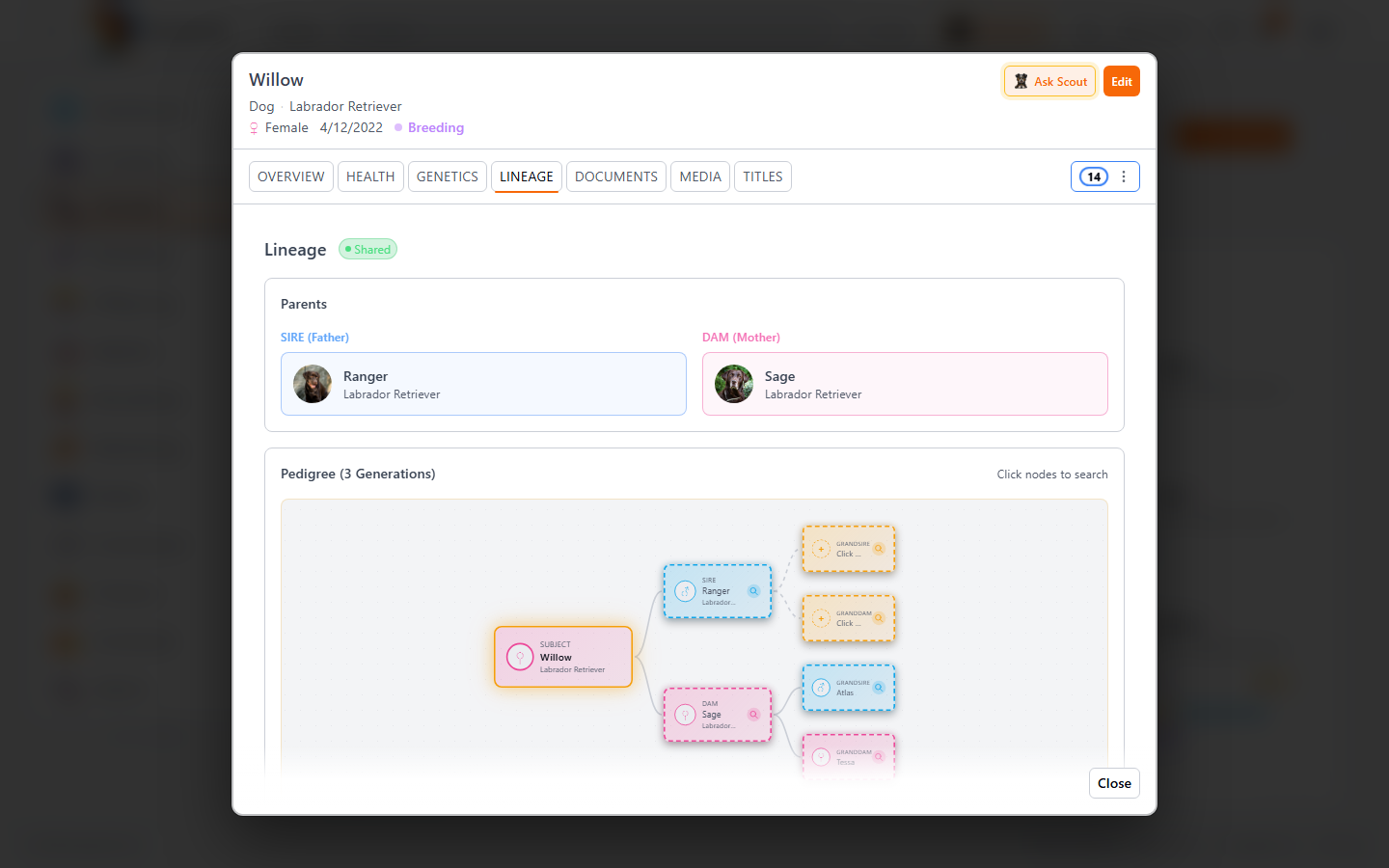
Every animal's lineage tree, automatically linked to health records and genetic results, share it with buyers in one click.
You already know your lines. Here's where it gets complicated.
The knowledge is in your head. The challenge is keeping it organized and accessible:
- •You can't answer basic questions about lineage
- •Inbreeding happens accidentally because you didn't check common ancestors
- •Buyers ask about pedigrees and you're scrambling to find papers
- •Breeding decisions lack context about ancestral traits
- •You can't trace where health issues originated
- •Registration paperwork is incomplete because you don't have complete lineage information
You use pedigrees to make real decisions. BreederHQ makes sure that information is at your fingertips when you need it.
The tools you've been using
Paper pedigrees in files
Registration papers with three or five generation pedigrees. Filed with each animal. They work, but finding common ancestors means pulling out papers and comparing by eye.
Generic pedigree databases
Online databases where you search for registered animals. Good for research. But the data lives separately from your animals, health testing, and breeding plans.
Pedigree software (standalone)
Dedicated pedigree programs that draw fancy charts. The pedigree data is isolated from everything else you track about your animals.
Handwritten charts
Draw the pedigree by hand when planning a breeding. Works once. Redrawing it for the next breeding is tedious.
Memory and familiarity
"I know the lines." This works until you need specifics. Or until you're considering a breeding with unfamiliar lineage.
Where those tools start to stretch thin
Pedigrees live in one place, records in another
You have a pedigree database. You have animal records. They don't talk to each other. When evaluating a breeding, you're switching between systems trying to connect the dots.
COI calculations take too long by hand
You know COI matters, but calculating it manually is complex and time-consuming. It's the kind of thing that's easy to skip when you're busy.
Common ancestors are invisible
Looking at two five-generation pedigrees side by side, trying to find who appears in both. This is error-prone and tedious. Software should do this instantly.
Ancestral health data stays in your head
You know the great-grandsire had a health issue, or that a certain line throws a specific trait. But that knowledge is in your head, not connected to the pedigree. When someone else looks at it, they don't see what you see.
Sharing pedigrees takes extra steps
A buyer wants a pedigree. You're scanning papers or using a separate program to generate a chart. It's not connected to the rest of their animal's information.
Hypothetical breedings require recreation
You want to see what a potential breeding's pedigree would look like. You're drawing it by hand or entering data into software temporarily. It's a lot of work for a "what if."
What it looks like when pedigrees are connected to everything
Pedigrees integrated with animal records
- •Each animal has a pedigree attached to their record
- •Sire and dam relationships tracked automatically
- •Multi-generation pedigrees generated on demand
- •No duplicate data entry
Automatic inbreeding calculations
- •Coefficient of inbreeding calculated for planned breedings
- •Common ancestors identified and highlighted
- •Multiple generations analyzed
- •No manual math required
Ancestral data preserved
- •Health testing visible on ancestral animals
- •Titles and accomplishments displayed
- •Notes about traits and characteristics preserved
- •Historical data informs breeding decisions
Visual pedigree charts
- •Clean, professional pedigree layouts
- •Multiple generation views
- •Printable and shareable formats
- •Customizable display options
Hypothetical breeding preview
- •See pedigree of potential offspring before breeding
- •Evaluate multiple stud options side by side
- •Inbreeding coefficient shown for each pairing
- •Plan before committing
How BreederHQ brings it all together
Pedigrees connected to animal records, not isolated in a separate database. Automatic COI calculations when planning breedings. Common ancestor detection. Ancestral health testing and accomplishments preserved. Professional pedigree charts shareable with buyers. Hypothetical breeding preview so you can evaluate pairings before committing.
You already know your lines. BreederHQ makes sure all that knowledge is organized, connected, and easy to share.
How BreederHQ compares to standalone pedigree tools
Most pedigree software does one thing: draw the chart. The question is whether that chart is connected to anything useful.
| Capability | Paper pedigrees | Standalone software | Generic databases | BreederHQ |
|---|---|---|---|---|
| Multi-generation pedigree charts | Manual | Yes | Yes | Yes |
| Automatic COI calculation | No | Varies | Varies | Yes |
| Common ancestor detection | No | Varies | No | Yes |
| Linked to your health records | No | No | No | Yes |
| Hypothetical breeding preview | No | Varies | No | Yes |
| Connected to genetics tools (coat color, lethal genes) | No | No | No | Yes |
| Shareable with buyers via portal | Manual scan or copy | Export only | Link sharing | Yes |
| Multi-species support | Yes | Varies by tool | Varies by tool | Yes (9 species) |
Standalone pedigree tools are not bad. They produce clean charts and many breeders use them effectively. The gap is that pedigree data lives separately from everything else: health records, breeding plans, genetics results, and buyer communications. Every time you need to connect those pieces, you do it manually. BreederHQ keeps them in the same place.
Built for breeders who:
- •Make breeding decisions based on lineage
- •Track multiple generations of breeding animals
- •Need to calculate inbreeding coefficients
- •Preserve ancestral health and accomplishment data
- •Share pedigrees professionally with buyers
- •Evaluate multiple breeding options before committing
This might be overkill if:
- •You breed unregistered animals without pedigree tracking
- •Pedigrees aren't relevant to your breeding decisions
- •You have simple lineage that's easy to remember
- •Paper pedigrees genuinely meet your needs
If lineage doesn't drive your breeding decisions, detailed pedigree tracking may not add value. BreederHQ is here when you're ready for it.
Frequently asked questions
Does it calculate coefficient of inbreeding?
Yes. When planning a breeding, the system calculates COI based on pedigree data.
Can I import pedigrees from other databases?
You'll need to enter pedigree data. Some breeders enter as they go, others batch-enter lineage for their foundation animals.
How many generations can I track?
As many as you enter. The system doesn't limit generation depth.
Can buyers see pedigrees?
Yes. Pedigrees can be shared through the buyer portal or exported as professional charts.
Does it show common ancestors in a planned breeding?
Yes. The system identifies and highlights common ancestors when evaluating a potential pairing.
Which animal species does BreederHQ support for pedigrees?
Pedigree tools are available for all nine species on the platform: dogs, cats, horses, goats, sheep, cattle, alpacas, llamas, and rabbits. The same pedigree, COI, and ancestor detection tools apply across species.
Is BreederHQ cloud-based or does it require installation?
BreederHQ is fully cloud-based. Your pedigree data is accessible from any browser, on any device, with no installation required. A mobile companion app is also available for on-the-go access.
Can I use pedigree data for genetics planning, like coat color predictions?
Yes. BreederHQ connects pedigree data to the Genetics and Health module, which includes multi-locus coat color analysis, COI calculation, and lethal gene warnings. Pedigree depth feeds directly into genetics tools rather than sitting in a separate system.