
What a Dog Heat Cycle Calculator Actually Tells You
Last Reviewed: May 16, 2026. Written and reviewed by the BreederHQ Operations Team, working with active dog breeders and reproductive veterinarians.
If you search for a dog heat cycle calculator, you are usually one of three breeders. The first is preparing for a planned breeding and wants to know when to start watching. The second has a dam in heat right now and wants to know whether she is past the breeding window. The third has just had a dam come into heat for the first time and is trying to understand what is happening.
A calculator helps all three, but only as a starting framework. This page explains what the math actually does, where it fails, and how to use the free tool without making decisions it cannot support.
Looking for the actual tool? The interactive calculator lives one click away.
Open the Free Heat Cycle Calculator →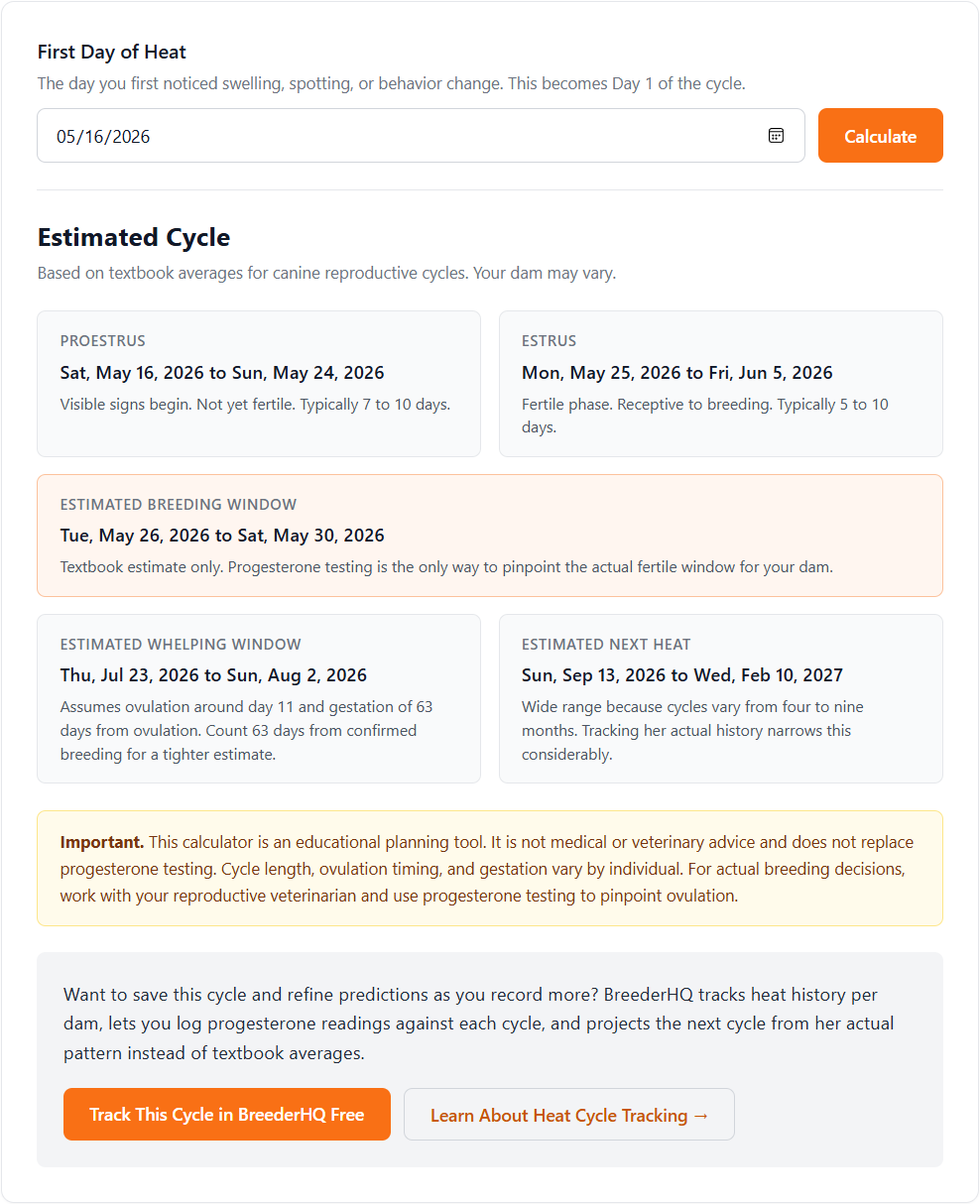
How a Dog Heat Cycle Calculator Works
Every dog heat cycle calculator does the same thing under the hood. It takes a single date (the first day of heat, Day 1 of proestrus) and applies textbook intervals to project the rest of the cycle. The intervals come from decades of canine reproductive literature and are well-established as averages.
Proestrus: Day 1 to Roughly Day 9
The visible start of the cycle. Vulva swells, discharge appears, intact males notice. She is not yet fertile. A calculator places this window first because the input date is its starting point.
Estrus: Roughly Day 10 to Day 21
The fertile phase. She becomes receptive. Ovulation occurs in this window, usually a few days after the LH surge. The estrus range a calculator shows is broad because the textbook range is broad.
Estimated Breeding Window: Roughly Day 11 to Day 15
This is the textbook overlap of "post-LH-surge" and "eggs mature enough to fertilize." A calculator can show this range, but it cannot tell you where in the range your dam actually is. Two dams whose proestrus starts on the same day will not necessarily ovulate on the same day.
Estimated Whelping: Roughly Day 69 to Day 79
Calculated as 63 days from estimated ovulation (around Day 11), with a buffer for ovulation-timing uncertainty. If the dam is bred and ovulation is confirmed by progesterone, the actual whelping date is far tighter: 63 days from ovulation, give or take a day or two.
Estimated Next Heat: Four to Nine Months Out
The textbook average is six months. Real dams cycle anywhere from four to nine months apart. A calculator shows the range because the range is real. Narrowing it requires tracking her actual cycle history over multiple seasons.
What a Heat Cycle Calculator Cannot Tell You
When Your Dam Actually Ovulates
Ovulation timing is driven by the LH surge, which only progesterone testing can pinpoint. The breeding window on a calculator is a textbook approximation. For natural cover where multiple ties are possible, that approximation can be enough. For chilled or frozen semen, it is not.
Whether Her Cycle Is Normal
Split heats, silent heats, and unusually short or long cycles all happen. A calculator assumes the cycle behaves like the textbook. If your dam has a history of split or silent heats, the calculator is not aware of that.
When the Next Cycle Will Land
The four-to-nine-month range a calculator shows for the next heat is just the textbook range. Your dam has her own rhythm. The only way to predict her next heat with real confidence is to track her actual intervals across multiple cycles.
Litter Size, Health, or Outcome
None of those are calendar math. They are determined by genetics, breeding-pair compatibility, timing accuracy, prenatal health, and a lot of other factors a calculator has no visibility into.
When a Calculator Is the Right Tool to Reach For
First-Time Breeder Trying to Understand the Cycle
If this is your first heat with this dam (or your first heat ever), a calculator gives you a mental map. You can see roughly where she should be on any given day and what should happen next.
Scheduling the First Progesterone Test
The estimated breeding window tells you when to plan to start P4 testing. Day 5 to 7 of proestrus is a typical first pull. The calculator helps you put that on the calendar so the test happens at the right time.
Coordinating with a Stud Owner
"She started heat on May 4, so we are looking at a breeding around mid-May" gives the stud owner a real window to work with. The actual breeding date will firm up from progesterone, but the calculator gives you the conversation-starter.
Communicating with Buyers
"If this breeding takes, we are looking at puppies around the end of July and go-home around early October" is the conversation buyers want to have. The calculator gives you the dates to share without overcommitting to them.
When a Calculator Is the Wrong Tool
Deciding When to Breed
Calendar math does not decide the breeding date. Progesterone does. Especially for chilled and frozen semen, the cost of breeding off the calculator instead of off P4 results is measured in lost litters and wasted shipments.
Tracking History Across Cycles
A standalone calculator forgets everything when you close the tab. It cannot show you "her last three cycles averaged 184 days" because it does not know about her last three cycles. Real tracking requires a system that persists.
Predicting an Irregular Cycler
If your dam has a history of split heats, silent heats, or wildly variable intervals, a textbook calculator will mislead more than it helps. The fix is to log what actually happens and use that pattern, not the textbook one.
Diagnosing a Reproductive Problem
A calculator is a planning tool, not a diagnostic. If a dam is cycling unusually, has missed conception repeatedly, or is showing signs of pyometra or other reproductive issues, that is a vet conversation.
Use the Free Calculator
Enter the first day of heat. The tool returns proestrus and estrus phase ranges, a rough breeding window, an estimated whelping window, and an approximate next-heat date. It is anonymous, no signup, nothing saved. Use it to plan when to start observing and when to book the first progesterone test.
For real cycle tracking (per-dam history, P4 trend charts, breeding records that tie to whelping math, waitlist movement when the litter resolves), the calculator stops being enough. That is what BreederHQ is for.
Important Limitations
- •A calculator is an educational planning tool, not medical or veterinary advice
- •It does not replace progesterone testing
- •Cycle length, ovulation timing, and gestation all vary by individual
- •First cycles are often irregular and may not follow textbook patterns
- •Frozen and chilled semen require precision that calendar math cannot provide
- •For actual breeding decisions, work with your reproductive veterinarian and use progesterone testing