
BreederHQ vs. Spreadsheets: When to Switch
Spreadsheets work. For a while.
They break at predictable points.
This page helps you know when you've hit that point.
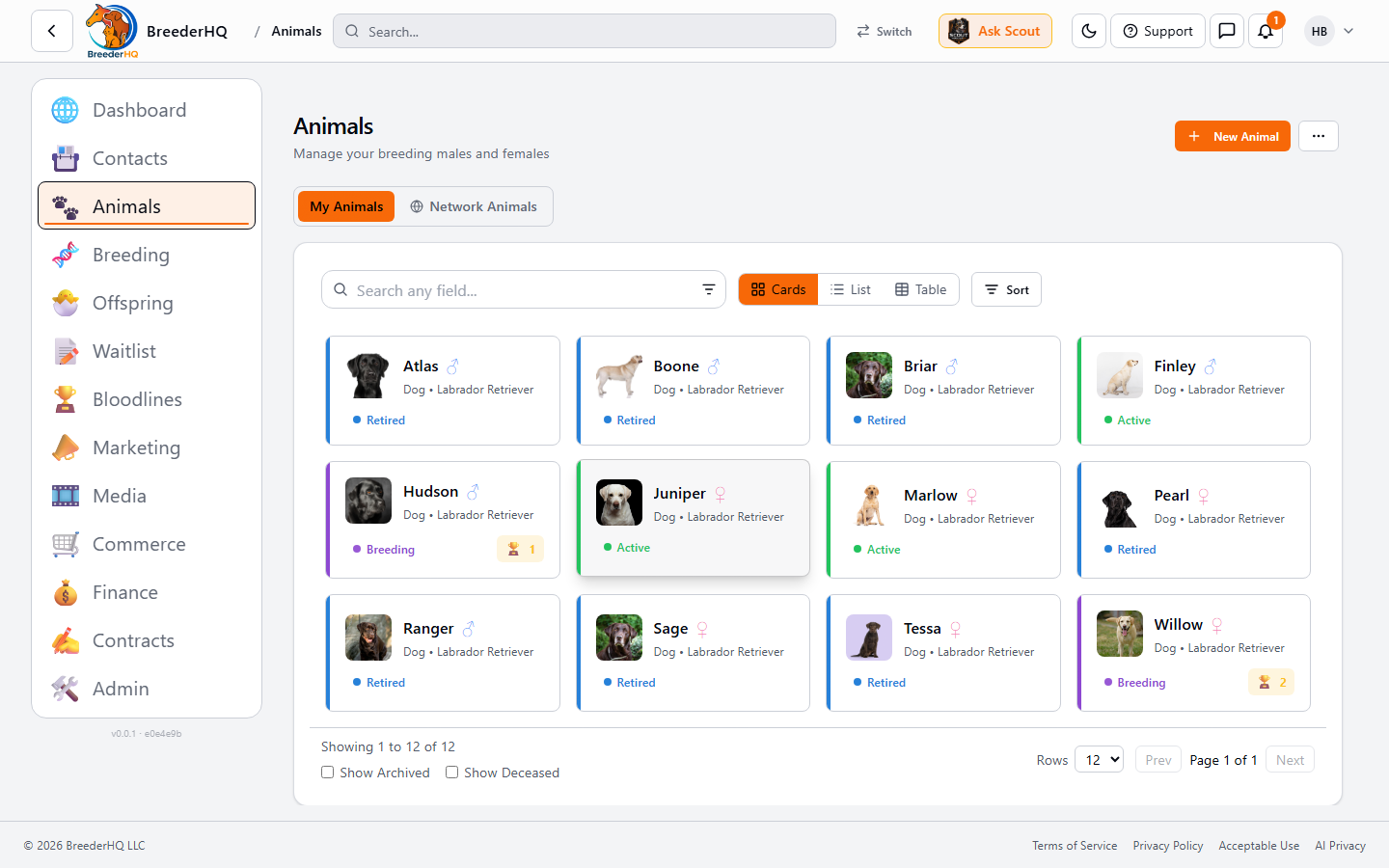
Every animal connected to its pedigree, health records, breeding plans, and offspring, not scattered across tabs in a spreadsheet.
When spreadsheets are fine
Spreadsheets are a reasonable choice when:
- •You have 1-5 animals
- •You produce occasional litters (1-2 per year)
- •You enjoy building and maintaining systems
- •You don't have a waitlist (or a very short one)
- •You're the only one who needs access
- •You don't mind being the database
Seriously: if a spreadsheet is working for you, keep using it. Software isn't always the answer. The best system is the one you'll actually use.
When spreadsheets stop working
Spreadsheets typically fail when:
Multiple breeding females with overlapping cycles
You can't see the conflict until it's a problem.
Waitlist longer than you can track mentally
Position, preferences, deposits, communication-too much for cells.
Buyers expecting regular updates and communication
Copy-pasting from a spreadsheet into texts isn't scalable.
Health testing records scattered across multiple files
The spreadsheet knows the test exists. It doesn't have the document.
Invoicing disconnected from animal records
Separate systems that don't talk to each other.
A partner, assistant, or family member needs access
"Let me send you the latest version" is a recipe for disaster.
You're spending more time on admin than animals
Data entry isn't why you started breeding.
You've forgotten something important more than once
The spreadsheet doesn't remind you. You have to remember to check it.
If three or more of these apply, you've probably outgrown spreadsheets.
Direct comparison
| Capability | Spreadsheet | BreederHQ |
|---|---|---|
| Animal records | ✓ (manual entry) | ✓ (structured) |
| Pedigree visualization | Manual or none | Automatic |
| Cycle tracking | ✓ (manual) | Predictive |
| Breeding calendar | Build your own | Built in |
| Date calculations | Formulas | Automatic |
| Genetics tracking | ✓ (manual) | Structured |
| Waitlist management | ✓ (manual) | Integrated |
| Client communication | Separate | Integrated |
| Buyer portal | Not possible | Included |
| Invoicing | Separate | Connected |
| Document storage | Separate | Attached |
| Mobile access | Varies | Yes |
| Multi-user access | Complicated | Simple |
| Reminders | Manual | Automatic |
| Cost | Free | Monthly subscription |
| Setup time | Hours to days | Minutes |
| Ongoing maintenance | Constant | Minimal |
What is your time worth?
If you spend 5+ hours per month on breeding administration-entering data, cross-referencing sheets, answering buyer questions, tracking payments, setting reminders, finding documents-then a monthly subscription pays for itself if it saves you even two hours.
More importantly: what's the cost of a mistake?
A missed breeding window. A forgotten health test renewal. A buyer who got the wrong information. A deposit you forgot to record. These aren't hypothetical. They happen when you're the single point of failure.
The real cost of spreadsheets isn't the software. It's your time. And the mistakes that happen when you're overloaded.
The bottom line
Spreadsheets are fine until they're not.
Most breeders hit the breaking point somewhere between 5 and 15 animals, or when they start having overlapping litters, or when their waitlist grows beyond a handful of people.
If you're there-if the spreadsheet is causing stress instead of reducing it-BreederHQ removes the chaos.
If you're not there yet, keep the spreadsheet. Bookmark this page. Come back when you need us.